Pages

Tuesday, December 29, 2020

Framingham Hospital and Training School for Nurses

In September of 1890, a group of civic minded residents petitioned the General Court of the Commonwealth to start a hospital in Framingham, Massachusetts, in part influenced and approved due to the increased use of the railroad that ran through the city.

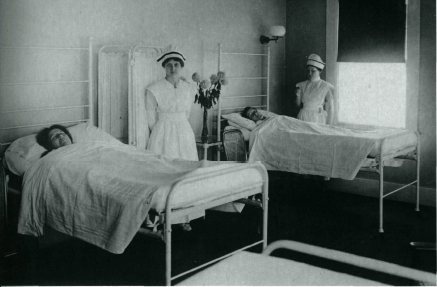
A gift of $5,000 was made in memory of Adolf Merriam, which spurred simultaneous efforts by a group of individuals – primarily women, who were the forerunners of the Framingham Hospital Aid Association – for the establishment of an emergency ward and independent training school for nurses. Their combined efforts culminated in 1893 when the Sturtevant House, which was located on Winthrop Street, opened its doors as Framingham Hospital and became the only public medical facility in Framingham.

Within four years funds were obtained to start a new hospital building on Evergreen Street, where physicians formed a medical staff organization, establishing rules and regulations governing the practice of medicine. They submitted a request for “an X-Ray apparatus” which was considered very progressive at the time, even for hospitals in larger cities.

FUH website 4-min


In 1912, Dr. Herbert O. Brenner left the Framingham Hospital on Evergreen Street to start his own hospital, The Union Avenue Hospital and also opened a school of nursing in 1913. In 1925, the Framingham & Union Avenue Hospitals were merged successfully to become Framingham Union Hospital. A 1927 ground breaking ceremony, attended by over 3000 guests, was held for the soon-to-be new Framingham Union Hospital facility. The combined nursing schools flourished, supported in part by the Hospital Aid Association. During WWII, they began the U.S. Cadet Nurse Corps Program, from which many graduates joined the armed forces.

In 1948, the U.S. Congress chose Framingham, Massachusetts and therefore Framingham Union Hospital as the location for its long-term cardiovascular research study. The Framingham Heart Study, which started with 5,209 adult subjects from Framingham, continues today, and is the longest longitudinal cardiovascular study in the United States. Much of what is “common knowledge” surrounding heart disease, such as the effects of exercise, diet and everyday medications like aspirin on heart disease is based on data collected during this study. It has received much attention from medical professionals as well has the popular media, and has been featured on “60 Minutes” and in People Magazine.

Throughout the second half of the last century, Framingham Union Hospital continued to grow, responding to the needs of Framingham and surrounding communities. In 1980, a 50,000 square foot addition was added, and the Cancer Care Center opened in 1986. In 1991, the new Women’s and Newborn unit opened, followed by the MetroWest Cardiac Center. Expansion and investment in technology has continued into the 21st century, most recently in 2018 with the addition of robotic technology and 3D mammography.


Monday, October 21, 2019

Saturday, June 9, 2018

Conflict of Interest in government


A Conflict of Interest arises when a public official is called upon to make decisions related to matters in which the official has a personal interest. That interest can be personal or financial.

Exposing and preventing potential conflicts of interest is an important step in ensuring that decisions made by government officials are based on what is best for the public.

While conflicts of interest can take many forms, they are particularly prevalent in government hiring, procurement/contracting and campaign finance.

In hiring, nepotism and patronage present a conflict of interest. Hiring friends and family based on connection to power rather than their ability to perform the job not only undermines the public trust, but also leads to a work force that lacks the skills for the job. In government contracting, procurement standards that promote competitive bidding are vital to preventing bid-rigging and awarding contracts based on relationships. Financing campaigns can also present conflicts of interest in which public officials are more beholden to donors than to constituent.

Framingham Policy of Ethical Conduct: https://www.framinghamma.gov/DocumentCenter/View/21382/Ethics

Tuesday, May 29, 2018

Transparency in government

from the Press Office of the United States Government 2015

Barack Obama: "My Administration is committed to creating an unprecedented level of openness in Government.  We will work together to ensure the public trust and establish a system of transparency, public participation, and collaboration. Openness will strengthen our democracy and promote efficiency and effectiveness in Government.


"Government should be transparent.  Transparency promotes accountability and provides information for citizens about what their Government is doing.  Information maintained by the Federal Government is a national asset. My Administration will take appropriate action, consistent with law and policy, to disclose information rapidly in forms that the public can readily find and use. Executive departments and agencies should harness

Friday, March 30, 2018

Accountability: An essential part of good government

Accountability, responsibility and transparency are some of the vital building blocks of good government. Government officials should serve the public interest, not act for personal gain. Citizens must be able to monitor their government, expose potential conflicts of interest and hold public officials accountable.

Vital building blocks of good government
The Freedom of Information Act and Open Meetings Law regulate what public documents citizens can obtain and how to acquire them. The Acts also dictate the public process governments must follow when they hold meetings.

Accountability in Government

Accountability ensures actions and decisions taken by public officials are subject to oversight so as to guarantee that government initiatives meet their stated objectives and respond to the needs of the community they are meant to be benefiting, thereby contributing to better governance and poverty reduction.


What is Accountability?

Broadly speaking, accountability exists when there is a relationship where an individual or body, and the performance of tasks or functions by that individual or body, are subject to another’s oversight, direction or request that they provide information or justification for their actions.

The concept of accountability involves two distinct stages: answerability and enforcement. Answerability refers to the obligation of the government, its agencies and public officials to provide information about their decisions and actions and to justify them to the public and those institutions of accountability tasked with providing oversight. Enforcement suggests that the public or the institution responsible for accountability can sanction the offending party or remedy the contravening behavior. As such, different institutions of accountability might be responsible for either or both of these stages.

Why is Accountability Important in Government?

Evaluating the ongoing effectiveness of public officials or public bodies ensures that they are performing to their full potential, providing value for money in the provision of public services, instilling confidence in the government and being responsive to the community they are meant to be serving.

----------------------
Comment:  

     Democracy and Good Government require accountability, and accountability requires transparency...
     The Freedom of Information Act should be administered with a clear presumption: "In the face of doubt, openness prevails...  "Non-disclosure should never be based on an effort to protect the personal interests of Government officials at the expense of those they are supposed to serve...
     The presumption of disclosure also means that agencies should take affirmative steps to make information public. They should not wait for specific requests from the public... Disclosure should be timely...

Excerpts from the United State Freedom of Information Act

Monday, January 15, 2018

In South Framingham, ‘hope springs eternal’ for cleanup of polluted sites

From the Metrowest Daily News
By Jonathan Dame, Metrowest Daily News Staff


Jan 14, 2018 - On the first Saturday after the Fourth of July in 2013, Judy Grove visited Pelham Apartments to learn for herself: Where do the children living in the subsidized housing complex go to play?

During her visit, she suggested a few possibilites, including nearby Mary Dennison Park.“Where’s Mary Dennison Park?” Grove recalled one the kids asking.

For the past six years since becoming Town Meeting Chair of Precinct 15 and recently elected as City Councilor for District 8, Judith Grove has worked tirelessly to bring attention to the concerns of the Southside conditions and its residents. Judy has brought awareness of the extent of contamination such as at Mary Dennison Park and the land at 350 Irving Street. She has fought for safe and healthy playgrounds and improve recreation for children. Judy has been persistent in her efforts to revive a 15 year effort and has been successful in making a skatepark become a reality. The news article that has appeared on the front page of the Sunday Metro West Daily News has detailed her work over the years. There are encouraging signs that problems in the Environmental Justice neighborhood will be corrected.


She told them the park was a half-mile away from where they lived in South Framingham, and that it had a few softball fields and basketball courts, and a playground for toddlers.

“Oh, it has a name?” the kids said, according to Grove. “Oh, we don’t go there.”

This was Judy Grove’s first foray into Framingham politics. Town Meeting had just rejected several citizens petitions for community and recreational programs in South Framingham. So she and others set their sights on redesigning Mary Dennison

The group eventually collected hundreds of signatures to improve the park, proposing picnic tables and a paved walking path, skateboarding ramps and a playground for older kids. They had momentum.

Then the town discovered the park’s soil was contaminated with lead. The tot lot was temporarily shuttered, its dirty soil hauled away and replaced, but most of the 17 acres were considered safe enough to keep using.

Thursday, November 16, 2017

Environmental Injustice in Southside

Framingham is a community of over 68,000 people inhabiting an area of 25 square miles and possessing a diversity of neighborhoods and people.

Most of us are familiar with the lovely neighborhood of the Framingham Centre Village Green which is bordered by the Village Hall, the History Center and colonial churches. We look forward to the Farmer’s Market and the Concerts on the Common.

On the southeast corner of Framingham is an area about twice this size. It is bounded by Beaver Street, Leland Street and Irving Street. Within this densely populated area are three known toxic chemical sites. This is an Environmental Justice Neighborhood.

For over 100 years (late 1880s to 1960s) companies like Dennison Corporation, Old Colony Tar Company and Com Gas located factories there because the area possessed railroads, waterways and a ready population of workers. These businesses brought jobs and prosperity to Framingham. Their owners sat on our Town Boards and donated civic buildings. However they also polluted our land and waterways with carcinogenic toxins such as coal tar, coal tar creosote, lead, chromium, arsenic and cyanide.

The U.S. EPA defines Environmental Justice as “the fair treatment and meaningful involvement of all people regardless of race, color, sex, national origin, or income with respect to the development, implementation and enforcement of environmental laws, regulation and policies.”

Tuesday, November 7, 2017

The (Harvard) College Lands identified in 1699 map

(draft)

The College Lands

Excerpts from "History of Framingham 1640-1880" by J.H. Temple
(Read from book: https://archive.org/stream/historyofframing00temp#page/n3/mode/2up

(p.104-105)
    In a codicil to his will, Mr. Danforth, under the heading "Deeds of gift," specifies: "To the College three tenements on lease to Benjamin Whitney, John Whitney, Isaac Bowen, situate at Framingham, on such conditions as I shall name." These three tenements were the sixty acres granted to Richard Wayte, and purchased of him by Mr. Danforth, lying northeast of Waushakum pond, and extending to the Beaver dam. This tract was leased by Mr. Danforth to the parties above named, who built three houses near each other, on the road northeast from the pond. The Sturtevant house occupies the place of Benj. Whitney's, which was the middle one of the three. After Mr. Danforth's decease the lessees paid the rents to Harvard College. Mr. Bowen sold his lease to Moses Haven, who (or his sons) bought out the Whitneys. Prof. Pierce, in his History of Harvard College, states that the College sold its Framing- ham lands to Mr. Haven for ;!^ioo in 1764. But in the valuation of 1771, Dea. Moses Haven is taxed ^3 on College land; and in 1772 the town voted that the constable be directed not to distrain those persons that occupy College land for their Province tax levied on said lands, till further orders from the town. This vote was reversed at the May meeting same year.

Overlay of College Lands and present streets

Monday, November 6, 2017

Skatepark construction underway

Final selected site for skatepark

October 2, 2017
October 2, 2017
October 2, 2017
October 2, 2017

October 26, 2017
October 26, 2017


October 26, 2017
November 3, 2017

November 3, 2017

This 2015 rendering shows what a skatepark along Dudley Road at Farm Pond might look like. After 15 years of promises and disappointments, Town Meeting approved funds to begin construction. Through the tireless efforts
of Judith Grove, the skatepark is becoming a reality. Situated in a park-like setting with water views of Farm Pond, the skatepark will be another treasure for Framingham youngsters added to the Cushing Park complex.